Biography
|
|
Audrey Tonai-Yamada
Honolulu, Hawaii
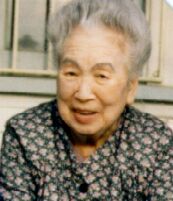
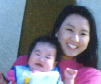
As I sit in front of my computer, my three-year old daughter, Jessica, asks what am I writing. I tell her I'm writing about my grandmother, her great-grandmother. Jessica met Grandma when she was five months old and then again at one year. She's much too young to remember Grandma, but I know a day will come when she'll ask about Grandma, just as I wondered about my great-grandparents. This is what I would tell Jessica about her great-grandmother.
Growing up, my brother and sisters and I spent long hot summers in Stockton. Even during the three years we lived in Japan, we came back each and every year.
My earliest memories of Stockton are dozing off in church only to be rudely awakened when my nodding head bumped the backrest of the bench. And the time my younger sister and I were fiddling around with our Ojuzu and broke the string, sending all the beads scattering across the floor of the church. I also remember gazing at the old photographs that lay neatly under a protective sheet of glass on the top of Grandma's dresser, and standing inches away from the living room air conditioner on the very rare occasion Grandma gave the "okay" for its use. I remember the times she would wake us up in the early morning hour to go fishing, how she called us, "Honey?" since it was easier to say then our names, and how we giggled when she called for our cousin Wayne, "Ween, Ween!"
Grandma told us about her childhood. She told us about the times she would have to go into the mountains as a young girl in Japan and catch eel with her bare hands. She said she disliked the chore because she didn't like to handle the eels. She told us about cooking for her family, her extended family, and all the workers at their store which added up to 15 (?) people or so. She told us how Grandpa, being slim and of short-statue, would carry 100 pound sacks of rice over his back, even having to go up flights of stairs to make his delivery.
Then there are things my grandparents did not tell us but did. For each and every grandchild they had invested their hard earned money so that all of us would have substantial savings for our college education. Our parents were able to cover our college expenses, so we were able to use that savings toward down payments on homes of our own.
Not only were our grandparents generous to us but also to others. As I grew older I always enjoyed looking through their photo albums and the many loose black and white photos. Some photos were of our family, great-uncles, great-grandparents, etc., and some were of complete strangers. I found one box filled with wedding photos of countless couples. Apparently, our grandparents acted as go-betweens/match-makers for many couples. Another box is filled with postcards from across the states, thanking our grandparents for helping them get back home after their release from the internment camps. Then there were the Yagis who, year after year, brought crates of fresh produce to our grandparents' house. I was told that this was in appreciation for helping their family during the depression. Our grandparents' kindness was truly appreciated and not forgotten.
I remember Grandma being disciplined and a disciplinarian, no-nonsense yet with a sense of humor, gracious, kind-hearted, resourceful, strong, multi-talented woman.
I remember when I was four years old and Dana was two. Grandma was visiting us in Japan and one day wound up babysitting us. Dana got banished to the bathroom for a temper tantrum and when Mom finally got home and Dana finally quieted down, we opened up the bathroom door to find Dana exhausted with the entire roll of toilet paper unwound. Grandma didn't take any sassiness and we all learned that one way or another.
But that's not to say she didn't have a sense of humor. Like when the crayfish we had rescued from Mickey Grove Park ended up crawling down the hallway and onto her bed in the middle of the night. In the morning, we were not admonished, in fact, she told us with a chuckle in her voice that the crayfish had escaped and ended up on her bed!
I also remember a time when Grandma received a dozen or more beautiful roses. She had them displayed in the living room but I think she viewed them more as an extravagant gift. As resourceful as she is, she decided to take this "impractical" gift and make it into something "practical." And so she did. She made the most delicious rose petal jam I had ever or will ever taste!
So, she can change the impractical to the practical but she can also take the mundane and create a beautiful work of art. I remember she visited us in Massachusetts and wanted to walk in the neighboring woods to collect plants for flower arrangements. It was autumn and the trees were becoming bare and I thought Grandma would be disappointed not being able to find anything decent for her arrangements. But she gathered twigs, ferns, and other foliage and created a beautiful arrangement.
It was not so much her cooking abilities, nor her accomplishment in flower arrangement but her creativity, ingenuity and the capacity to see beyond the obvious toward endless possibilities, which made her a woman I admired.
So Jessica, these are the things I would like you to know about your great-grandmother, her gracious sense of humor, her discipline, her generosity, and her wisdom. I can only hope that she saw beyond our youthful shenanigans, that she was greatly respected, appreciated and loved. As we were taught at the closing of each tea ceremony lesson, we respectfully sat on our folded legs, placed the sensu and our palms on the ground in front of our knees, bowed our heads and said, "Domo-arigatogozaimas " And Grandma in her infinite wisdom to see beyond the obvious, I know that she understood these words were not just gratitude for the lesson of tea but for all the invaluable lessons of life. I know Grandma will always be a part of me. The lessons she has given to us are woven intricately within each of us.
Rosalyn Tonai
Oakland, California
Here are our loving memories of Grandma....
As a teacher, Grandma made it a mission to teach her grandkids, particularly the rambunctious Tonai clan, the traditional Japanese arts of tea ceremony, flower arrangement and oroiri (cooking). Having lived in Tokyo during their formative years, we could understand the nuances of her English-Japanese dialect. Ros recalls the hours of tutelage under Grandma's watchful eyes at "Camp Stockton." "Your posture should be like samurai," she'd reprimand. We must have drunk so much caffeinated powdered green tea that we became stunted insomniacs during those long hot summer nights. Grandma would dress us up in our ukatas and make us up for Obon. Being the competitive bunch that we were, we were eager to show off our newly-acquired skills when our parents rejoined us at the end of summer.
To illustrate how we valued Grandma's insight & judgment of character, Rosalyn recalls bringing by her string of male friends to Stockton to have Grandma "check them out." She soon learned from grandma the meaning of "botchan" (spoiled brat)" shin-setsu (kind-hearted), " and "I don't shink so." To win some brownie points with Grandma, Ros suggested that they paint Grandma's house. I am sorry to say that my now husband Grant fell for it. It took us and the cousins all summer to finish that job.
Grandma as many of you know was quite direct in her ways. Grant recalls when Rosalyn and he got married--the same year Dean & Lori did. Then year later, grandma, who rarely spoke to him in English, grabbed his arm in the middle of dinner one day and said. "Honey, Har-ri Up! Har-ri up, make babies!" "But Grandma," he said, "We're waiting for Dean and Lori!" "Don't wait for them!" she snapped.
It took Dean and Lori a year and Ros and Grant five years before they hurried and had Kiyoshi, now six.
Kiyoshi says he has fond memories of doing chores for great-grandma with his cousin Masao like raking leaves, feeding the fish, washing the dishes, doing "hotoke sama" bringing, retrieving and eating the leftover rice from the Obutsudan, playing "Rush Hour," and counting her pennies.
Great-Grandma adored her five great-grandchildren and her last words to Kiyoshi and Masao were: "You are good boys."
We will miss her.
Sherie Ann Hashimoto
Davis, California
Grandma was very good about giving us constructive feedback on how we were doing. She said that Audrey was the only good wife because she did not talk back to her husband. I feel that the rest of us are just following Grandma's footsteps and lead since she was a strong woman. As a result, Roz's husband, Grant had to start an "Itos' Spouses Support Group" in which Dana's husband, Paul and my husband, John are charter members. They get together to commiserate on how terrible their spouses treat them.
One evening there were some of my cousins, John and I eating dinner at Grandma's house. Grandma noticed that John's chawan, rice bowl, was empty. She said to me "Get John some more gohan." Being the obedient wife that I am, I replied, "Why? Is he disabled?" So as John stands up to get his gohan and I hand him my chawan and said, "Can you get me some gohan?" to which Grandma replied "Bakka."
Grandma was very frugal and saved everything. I think it is because when she was growing up, her family was poor and she also lived through the depression and war. We had to wash out the plastic bags and reuse them over and over. She also saved the trays that raw meat comes in. If you throw anything out, like used take-out containers, she would go thru the trash and take it out. When her refrigerator broke and we got a new one, I took the tape off the box and proceeded to throw the tape away. Grandma said, "Don't throw the tape away. Save it."
For the last ten years, Grandma has been telling us when we visit her to write down our names on anything in the house that we want to inherit when she dies. I announced that I want all the plastic bags and used twisty tops. I am warning my cousins to keep away from those.
Grandma really enjoyed seeing her great grandchildren. She saw Masao, Dean and Lori's son and Kiyoshi., Roz and Grant's son a lot since they lived in the Bay Area. When Masao and Kiyoshi were babies, Grandma would mention that she took care of Dean when he was that same age until he was four.
Grandma always told me that I spoiled Masao and Kiyoshi. When they were babies, she told me that I held them too much. I told her I didn't think so and that you can never hold babies enough. I asked her if she held Dean all the time when he was a baby and she said no. I said, "See, look how he turned out. I rest my case."
Dana Tonai
Sylmar, California
There's a lot to remember about Grandma. We spent a lot of summers in Stockton. But one of the best things was the cooking. The tempura, the tomato soup, and for New Year's the inari sushi, the machi sushi, gobo, the osuimono, the konyaku and all the other fixings. I'm sure each of you had a favorite dish. The food was all so good. Now every time I eat in a Japanese restaurant. I remember Grandma. I think, "This sure doesn't taste as good as Grandma's." And every time I try to cook her recipes I think "This sure doesn't taste as good as Grandma's."
|